Returning to Biblical Femininity in a Modern World
In a world that constantly redefines what it means to be a woman, Scripture offers something the culture never can — a foundation that holds. This read is an honest, grace-filled exploration of what biblical femininity actually looks like: a posture of the heart rooted in God-given identity. Whether you're just beginning to ask the questions or returning to convictions you've always held, this is your invitation to come home to who God created you to be.
FAITH, IDENTITY & CHARACTER
IndeYah Emunah
5/18/20264 min read
Faithful Fashion Elegance
We live in a world that tells women they must constantly prove themselves — that strength means hardness, that worth is earned through achievement, and that femininity is a limitation to overcome. But what if the truest version of womanhood was never the one the culture prescribed?
The Question
What Does It Mean to Be a Biblical Woman Today?
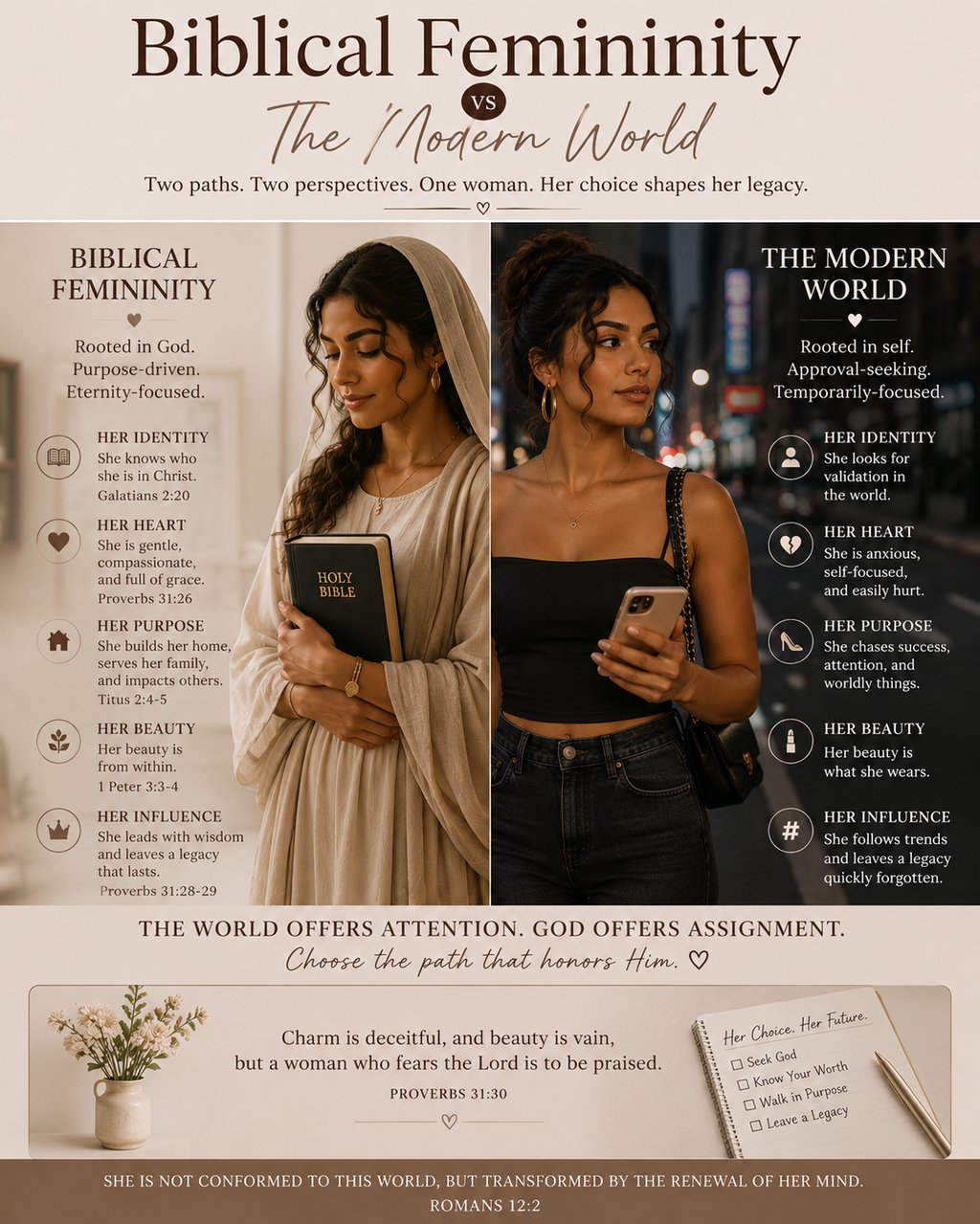
Before we can return to something, we have to understand what we're returning to. Biblical femininity is not a list of rules about hemlines and housework. It is an orientation of the heart — a way of moving through the world that is rooted in God-given identity rather than cultural approval.
The world offers women a shifting and exhausting standard: be bold, but not too bold. Be soft, but not weak. Climb the ladder, but don't seem ambitious. These contradictions are not freedom — they are a new kind of cage. Biblical womanhood offers something different: a foundation that does not move.
The Blueprint
What Scripture Actually Says
The most famous portrait of biblical femininity is Proverbs 31. For many women, this passage has felt like a standard impossible to meet — a never-sleeping, always-producing superwoman. But read slowly, with fresh eyes, and something remarkable emerges: this woman is described not primarily by what she does, but by who she is.
She is clothed with strength and dignity, and she laughs without fear of the future. She speaks with wisdom, and faithful instruction is on her tongue.
Proverbs 31:25–26
Notice what comes first: strength and dignity. Not productivity. Not performance. She is not striving — she is grounded. Her laughter is not the nervous giggle of someone who fears she is not enough. It is the deep, settled joy of a woman who knows who she belongs to.
Scripture also gives us Mary, who sat at Jesus' feet when every cultural expectation told her to stay in the kitchen. It gives us Deborah, a judge and military leader, whom God used in extraordinary ways. It gives us Ruth, whose loyalty and steadfastness became the very lineage of Christ. Biblical womanhood is not one shape — it is one spirit.
The Tension
When Culture and Scripture Collide
Modern culture has redefined strength as independence and softness as weakness. Returning to biblical femininity does not mean agreeing with that framing and then choosing the "weaker" option. It means rejecting the framing entirely.
There is a profound strength in gentleness. There is extraordinary courage in nurturing. There is deep wisdom in submission — not as an act of inferiority, but as a chosen posture of trust in a structure God designed. The woman who serves her family sacrificially, who guards her home with intention, who prays with fierce conviction — she is not less than the woman who commands a boardroom. She is simply answering a different calling with equal ferocity.
The world calls it weakness. Scripture calls it power under control.
Biblical femininity does not ask women to disappear. It asks them to be fully, beautifully present — in the roles and relationships where God has placed them — with their whole heart, not a performance of one.
The Practice
What This Looks Like in Everyday Life
Returning to biblical femininity is less a dramatic overhaul and more a quiet reorientation. It begins in the interior: with the questions we ask ourselves, the voices we allow to shape us, the values we let govern our choices.
Cultivating inner beauty over outward performance.1 Peter 3:4 calls women to a "gentle and quiet spirit" — not a personality type, but a settled, unshakeable confidence rooted in God rather than in the approval of others.
Embracing the body and the role of life-giving.Whether biological or spiritual, women are uniquely designed to nurture, create, and sustain life. Honoring that capacity is not limitation — it is participation in God's ongoing work.
Choosing wisdom over noise.The Proverbs 31 woman "speaks with wisdom." In a culture of constant opinion, learning to speak with intention and listen deeply is countercultural and profoundly powerful.
Building and protecting the home.Proverbs 14:1 says, "The wise woman builds her house." This is not about physical structure alone — it is about the atmosphere, the culture, and the spiritual health of the environment entrusted to her.
Finding identity in Christ, not culture.The most radical act of biblical femininity in a modern world is the refusal to let trending ideologies define your worth. You are known, named, and deeply loved by God — and that is enough.
The Invitation
This Is Not a Step Backward
There is a fear — sometimes spoken, often unspoken — that embracing biblical femininity means surrendering hard-won ground. That choosing to prioritize home, husband, or faith community is a retreat from progress.
But consider this: true progress is not about conforming to whoever holds cultural power at the moment. It is about freedom — the freedom to live according to your actual design, your actual calling, your actual convictions. A woman who chooses to live according to Scripture in a world that mocks her for it is not surrendering strength. She is exercising it.
Charm is deceptive, and beauty is fleeting; but a woman who fears the Lord is to be praised.
Proverbs 31:30
The praise Scripture points toward is not the applause of social media or the affirmation of peers. It is something quieter and more enduring: the deep, bone-level knowledge that you have lived faithfully. That you have loved well. That you have been, fully and without apology, who God created you to be.
Where Do You Begin?
You begin exactly where you are. Not with a complete transformation, but with a single honest question: Where have I let the culture tell me who I am, instead of letting God tell me?
Then you bring that question — and every answer that surfaces — to the One who called you daughter before the world called you anything else. From that place, biblical femininity is not a burden. It is a homecoming.